Pioneering Progress: An interview with Lucy Jung on the impact of Cambridge NeuroWorks
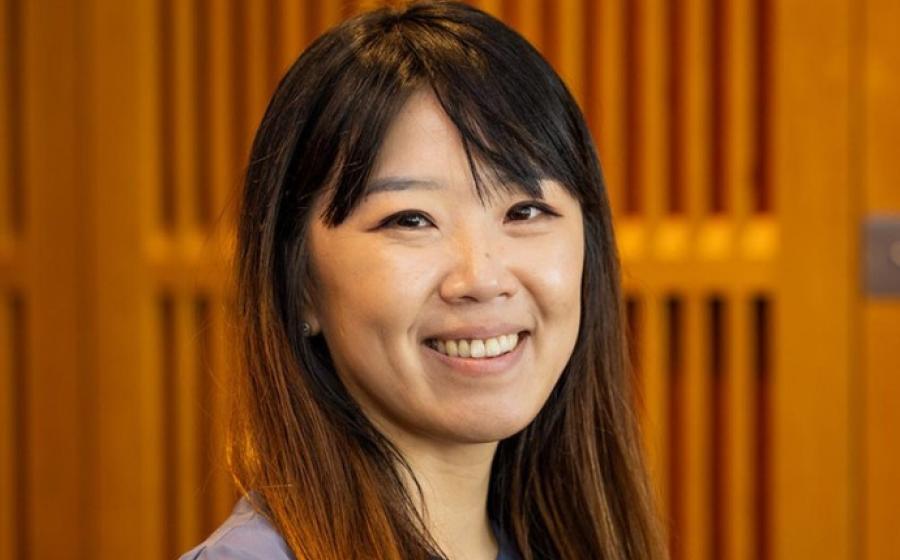
Cambridge NeuroWorks, powered by ARIA, is more than just a fellowship—it’s a thriving ecosystem designed to accelerate neurotechnology from concept to reality. Lucy Jung’s mission at her start-up company LYEONS Neurotech is deeply personal. A second-time neurotech founder who was operated on for a brain tumour in her 20s, she draws on her own experiences with neurological and health challenges to drive her work forward. Below, she shares how this personal alignment led her to the Frontier Fellowship and how the community transformed her journey from a single circuit board to a regulatory-certified product.
The power of community and campus
Interviewer: Your desire to work in neurotech has been driven by a very personal experience hasn’t it?
Yes. I was diagnosed with a brain tumour in 2014, when I was 26, and had brain surgery at 27. It was a small benign tumour, but its location meant the symptoms affected my day-to-day life very quickly. In addition, for some reason my symptoms were not following the usual pattern, so it was harder to manage. At one point I was not able to walk or see properly - hence I had to leave my studies at Imperial College London for 5 years. The brain surgery journey was quite complicated; the surgeons weren't able to remove all of the tumour due to the risks involved.
I had to completely change my life plans. At the time, I was advised that my best chance of having children would be sooner rather than later due to the relatively high chance of the tumour growing back, so my children were born in 2016 and 2018.
My passion for neurotechnology comes from these experiences, so for that I am grateful. Whether it relates to movement symptoms or non-movement symptoms, neurological conditions can have a huge impact on people’s lives. Many of the symptoms are invisible, diagnoses can be difficult, and the experiences are often complicated and hard for patients to explain. For example, I have balance issues which can make life very challenging, yet we still don’t know whether it was the surgery or the medication that caused them.
A few weeks ago, I spent 13 hours in A&E at Addenbrooke’s hospital having various tests. Experiences like that bring me back to the importance of thinking carefully about the patient journey when we are developing new technologies.
Interviewer: To start, what impact has being based on a campus - or having access to the Cambridge NeuroWorks network - had on your journey?
Lucy: For us, I truly wish we had moved to the Babraham Research Campus earlier. Initially, we didn’t realize we could have a dedicated office, we thought only I could come in, but we’ve had a full team from the beginning. As soon as the office space was provided by the Babraham Research Campus, a Cambridge NeuroWorks Partner, everything started working really well.
The community is ideal for our needs. The proximity to the Cambridge NeuroWorks team, some situated on the Babraham Research Campus means I can quickly jump in to say hi, seek advice, or brainstorm. The project acceleration has been huge. For our research participation, we were originally looking for 34 people, but by sharing the study across the network — including the Milner Therapeutics Institute, the Maxwell Centre, the Babraham Research Campus, Cambridgeshire and Peterborough Foundation Trust and Cambridge Network - we quickly reached 57. That impact came directly from the Babraham Research Campus's reach. Beyond that, brainstorming with other fellows feels like having an extended team. Even though we are different companies, we help each other as if we’re on the same project.
Interviewer: When did you first hear about Cambridge NeuroWorks?
Lucy: Through my connection with John Gourd, CEO of the Cambridge Network, I learned about Cambridge NeuroWorks’ ‘neuro voice’ community, and I was immediately excited by how aligned the initiative felt.
Neurotechnology requires many stakeholders — scientists, clinicians, and finance experts — to work together from the start. Cambridge NeuroWorks enabled that collaboration. While the grant was helpful, the access to experts to "sense-check" our progress was the real key.
Interviewer: I spoke with Jonathan Best (Cambridge NeuroWorks Fellowship Operations Manager) recently, and he mentioned the fellows have their own miniature ecosystem. That’s exactly the environment we want to foster.
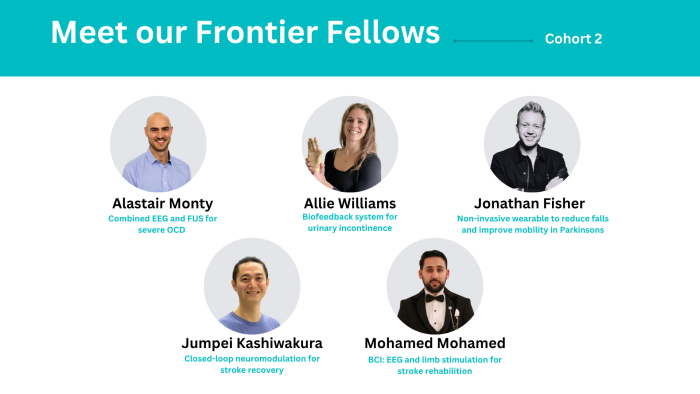
Lucy: Especially with neurotechnology, there is so much to share—hardware, software, firmware, or even business strategy and financing. There’s a lot of synergy. For example, another Frontier fellow, Iwan Roberts, quickly 3D-printed a mould for us, which really sped up our development. I’m particularly interested in Iwan Roberts’ work developing wearable tech for balance and neurological monitoring, his project resonates with me personally as having had a brain tumour means I also manage these same symptoms. It’s also very good for morale; the founders here are impact-driven and patient-centric. I don’t think I’ve ever met a founder here who is purely in it for money. Hearing their stories is always incredibly inspiring.
Milestones and rapid acceleration
Interviewer: What have been the key milestones on your journey so far?
Lucy: There have been many. I’ve tried to utilize this fellowship period as much as possible because having access to such an expert resource institute is a unique opportunity.
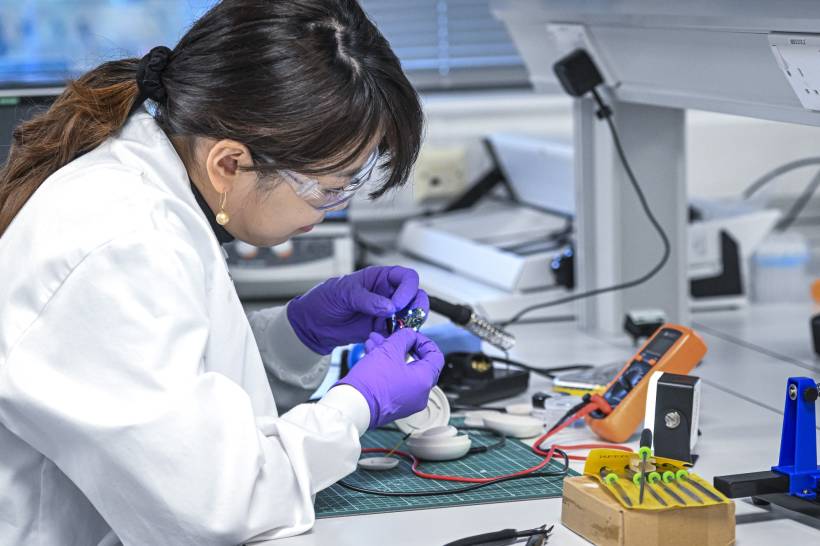
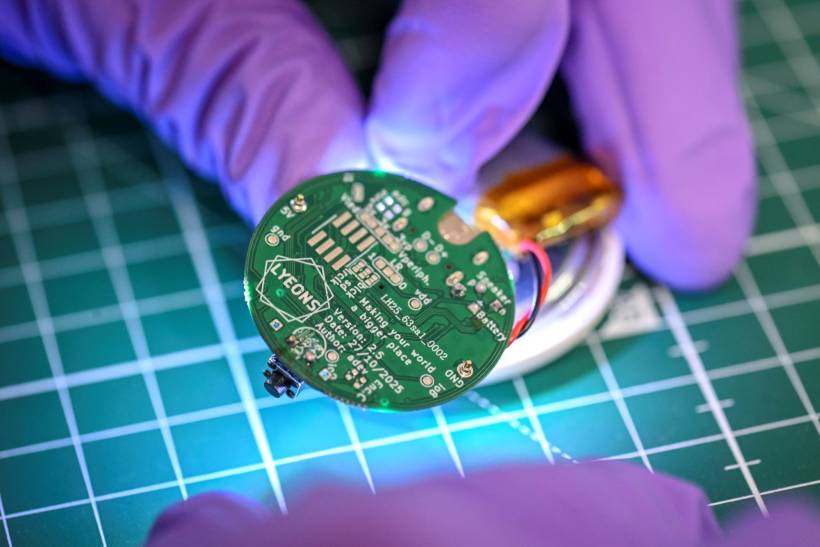
When we joined, we had no product - just a stripped proof of concept. Now, we are leaving with a product that is CE and UKCA marked, and we are preparing for US and Korean regulatory certification. We’ve also tapped into expertise on how to use an EEG (an Electroencephalogram, a non-invasive, neuroimaging device in the form of a skull cap that records the electrical activity of the brain), clinical studies, and psychology, which boosted our technical development. We went from carrying out a literature review to preparing for a 100-unit production run. We’ve even completed health economic benefit analyses to understand our impact better.
Interviewer: What’s next for the team?
Lucy: This year has given our founding team a real perspective on who we are as founders. Through talking with experts and inspiring people, we’ve realized we don’t want to be a single-product company.
LYEONS Heart is a handheld device that uses adaptable, heartbeat-like sensory stimuli to help users regulate their physiological state for better rest or focus. By combining this tactile feedback with a companion app for data tracking, the system personalizes its approach to individual needs over time. Beyond general stress and sleep support, ongoing research is exploring how this sensory modulation can specifically assist neurodiverse and neurological populations in managing central nervous system responses.
This is just the beginning; we aim to produce many more innovations in the sector to fundamentally change how brain health is managed.
From networking to core team
Interviewer: It feels like the journey is just beginning.
Lucy: It really is. I see a major shift toward collaboration rather than competition. We’ve actually met many of our team members through Cambridge NeuroWorks events. Out of our team, several people we met through networking ended up collaborating on papers or joining us as key members.
Having that "safety net" where you can try, fail, and try again with genuine support from people behind the scenes at The Babraham Institute means everything. It helps my personal growth as well as the company’s, providing a sense of family and security that is rare in the startup world.