Meet Frontier Fellows at Cambridge NeuroWorks - Cohort 2
Frontier Fellows will continue to advance their early-stage innovations, drawing on commercial insight and ecosystem support as they prepare for real-world impact. Their journey begins with Accelerate@Babraham at the Babraham Research Campus, equipping them with the tools and expertise to take their ideas further, faster.
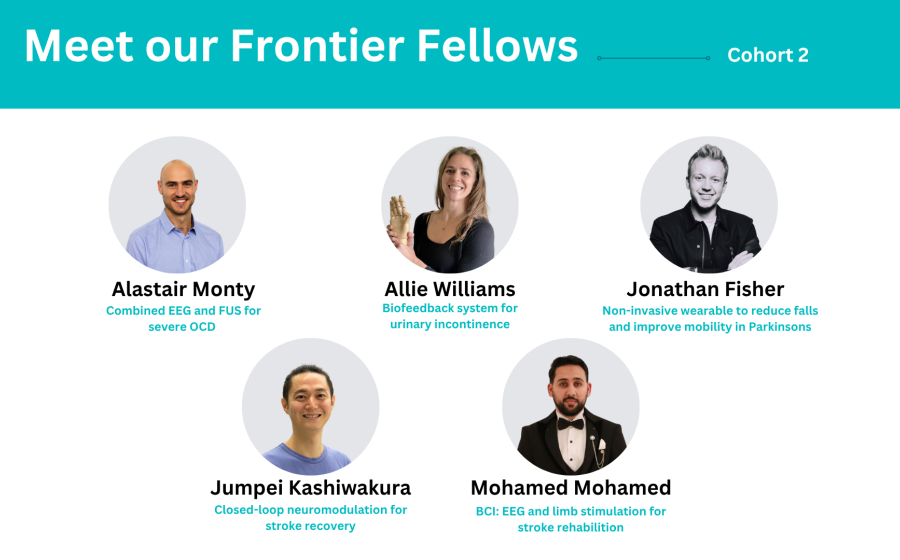
Alastair Monty
Alastair is the founder and CEO of Mendea Technologies. After stepping away from corporate law, he became interested in meditation and neuromodulation research, connecting directly with scientists before founding a company focused on improving how the mind works.
The starting conviction from meditation was simple: if the mind works better, life is better. Alastair chose OCD, a condition affecting over 750,000 people in the UK, where about half of patients don't get relief from medication and therapy.
Alastair wants to use focussed ultrasound - concentrated soundwaves which can change neural behaviour when focussed onto precise points - to calm overactive circuits in OCD patients' brains. A patient would wear a lightweight headset in a clinic during a therapy session, with real-time brain monitoring personalising the treatment.
As Frontier Fellow, hosted by the Babraham Research Campus, Alastair will explore: Combined EEG and FUS for severe OCD
Allie Williams
Allie is a PhD researcher in cognitive neuroscience at the University of Cambridge in the Plasticity Lab. Her research focuses on motor learning and proprioception. Her work is informed by her background as a yoga teacher, where she developed techniques to build awareness of muscle use.
She has created a closed-loop, non-invasive wearable biofeedback system to support training for pelvic floor dysfunction — a condition affecting around 1 in 3 women and millions of men. The system uses surface sensors to measure muscle engagement and provide real-time feedback during everyday movement.
With her cofounders, she is developing an accessible wearable platform for rehabilitation and training across muscle systems, focusing on brain-based training rather than just muscles.
As Frontier Fellow, hosted by The Milner Therapeutics Institute, Allie will explore: Biofeedback system for urinary incontinence
Jonathan Fisher
After witnessing his father’s struggle with Parkinson’s Disease, Jonathan was inspired to develop 'Peter', a wearable biomedical device designed to help people with Parkinson’s walk again.
Jonathan is an award-winning designer with a background in consumer electronics, holding a BSc in Product Design from Brunel University London and an MPhil in Industrial Systems, Manufacture and Management from the University of Cambridge.
After a trailblazing year developing “Peter” as a Blue Sky Fellow, Jonathan joins the programme as Frontier Fellow to translate “Peter” to life, determined to improve the lives of people with Parkinson’s Disease around the world.
As Frontier Fellow, hosted by the Maxwell Centre, Jonathan will explore: Non-invasive wearable to reduce falls and improve mobility in Parkinsons
Jumpei Kashiwakura
After completing his MEng at Waseda University, Jumpei spent five years at Toyota Motor Corporation working on hybrid vehicle systems and developing expertise in Toyota’s problem-solving methodologies.
In 2018, he moved into bioengineering with an MSc at Imperial College London and later worked as a Research Associate in neurorehabilitation, leading assistive device projects.
Building on this work, in 2024 he co-founded Neubond, an Imperial spin-out developing wearable neural interface technology for stroke rehabilitation. The device, designed in a watch-like form factor, monitors muscle activity and delivers therapy to support motor recovery. It aims to address gaps in rehabilitation by brining hospital care to home for a continuous care.
As Frontier Fellow, hosted by the Babraham Research Campus, Jumpei will explore: Closed-loop neuromodulation for stroke recovery
Mohamed Mohamed
Dr. Mohamed is a Research Associate at the University of Sheffield, working at the intersection of brain-computer interfaces and rehabilitation technologies. His work focuses on developing practical solutions that translate neuroscience research into real-world impact, particularly for people recovering from stroke.
His current project, TeleRegain, aims to address a major challenge in stroke recovery: limited access to effective rehabilitation. Many stroke survivors do not receive enough therapy due to time, cost, and resource constraints, which can slow down or limit their recovery.
TeleRegain is a home-based rehabilitation system that interprets a patient’s movement intention and uses it to drive assisted physical therapy in real time. The system is designed to be portable and easy to use at home, allowing patients to carry out rehabilitation independently on a daily basis.
As Frontier Fellow, hosted by the Babraham Research Campus, Mohamed will explore: BCI: EEG and limb stimulation for stroke rehabilitation
Stay up to date with Fellow updates, discussions and upcoming events on Connect: Health Tech.