Meet Blue Sky Fellows at Cambridge NeuroWorks - Cohort 2
Blue Sky Fellows will explore bold, high-risk ideas in neurotechnology through a 3-month “What If” ideation phase, followed by a 9-month proof-of-concept (PoC) phase, rapidly iterating between What if and PoC as they test their hypotheses and pursue their winning concept for transformative neurotech innovation.
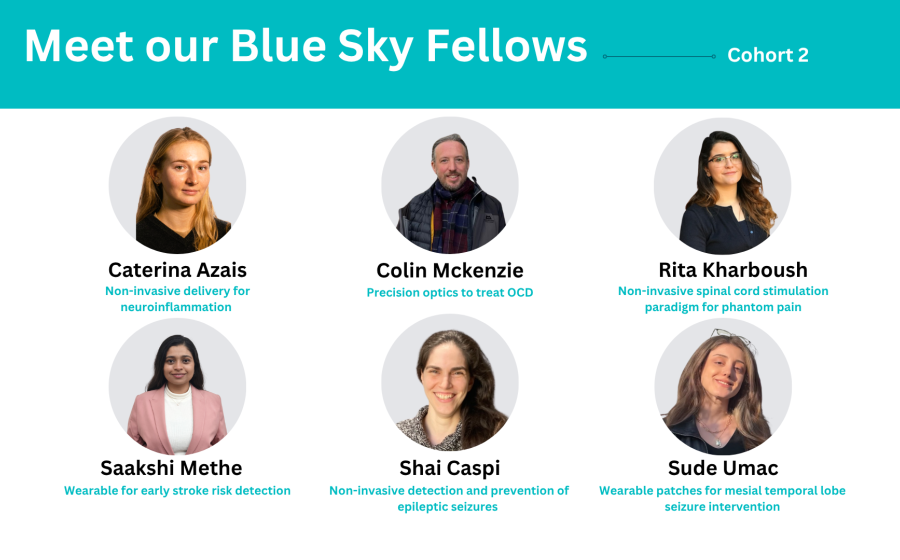
Caterina Azais
Cate is a biomedical engineer trained at Imperial College London. She has worked across academia and three neurotechnology startups, driven by a consistent focus on real-world impact and clinical translation. This led her to join Entrepreneurs First and found Aequa.
Implantable neural devices are the gold standard for a growing number of neurological and psychiatric conditions, but <1% of eligible patients ever receive them, because access requires a neurosurgeon, an operating room, and a willingness to have your skull drilled open. Aequa's mission is to make brain surgery obsolete: delivering single-neuron resolution, with the same precision and efficacy as implants, without a single incision.
Cate is laying the roadmap from scientific breakthrough to clinical translation: initiating regulatory conversations, building commercial foundations, and continuing to advance a preclinical safety programme.
As Blue Sky Fellow, hosted by The Milner Therapeutics Institute, Caterina will explore: Non-invasive delivery for neuroinflammation.
Colin Mckenzie
Colin’s career has focused on understanding the causes of brain disease, with recent work exploring the neurobiology of compulsive disorders. He has long been interested in electronics and experimental methods, developing expertise in measuring neuronal activity. Colin is now applying his expertise in molecular biology, neural circuits and behavioural psychology to develop next-generation treatments for OCD.
Currently there are only two main treatment options for OCD: therapy and medication, both of which are ineffective in up to half of patients. Colin aims to change this.
As a Blue Sky Fellow, Colin will explore the use of precision optics to develop new, minimally invasive treatments for OCD. Having witnessed the effects of OCD first-hand, Colin’s vision is to empower OCD patients with an effective, personalised, and anytime treatment option.
As Blue Sky Fellow, hosted by the Maxwell Centre, Colin will explore: Precision optics to treat OCD.
Rita Kharboush
Rita is a biomedical engineer whose PhD at Imperial College London focused on non-invasive spinal stimulation for upper limb amputees. Her motivation comes from working directly with amputees, witnessing the frustration of phantom limbs trapped in painful positions for years with no effective treatment available.
Her project addresses phantom limb paralysis, a condition where amputees' missing limbs become "frozen" in painful positions like a permanently clenched fist. Current treatments try to mask the pain, but none restore the lost ability to move.
Rita’s device combines gentle spinal stimulation with muscle sensors to help users regain control of phantom limbs, reduce pain and rebuild neural connections after amputation.
As Blue Sky Fellow, hosted by the Maxwell Centre, Rita will explore: Non-invasive spinal cord stimulation paradigm for phantom pain.
Saakshi Methe
Saakshi Methe is a bioengineer with an MRes in Medical Device Design and Entrepreneurship from Imperial College London. She is driven by the belief that the best technology is built with empathy, designed around the people who need it most. Her work is guided by one question: what would it take to stop a stroke before it happens?
Stroke is a leading cause of death and disability worldwide, yet for millions of people at high risk, there is no way to monitor their health between hospital visits. By the time a stroke is detected, it is often already too late.
Saakshi is developing a wearable device to continuously track blood flow to the brain, alerting caregivers when the blood flow drops to critical levels, giving patients and clinicians the precious time needed to intervene. Her ambition is to make stroke care proactive.
As Blue Sky Fellow, hosted by Babraham Research Campus, Saakshi will explore: Wearable for early stroke risk detection.
Shai Caspi
Shai is a data scientist with experience in cognitive neuroscience who is passionate about making a difference to people’s life through non-invasive interventions for neurological conditions.
Her project is looking into a wearable device that can treat epileptic seizures through a targeted, non-invasive interaction with the brain.
“Imagine wearing a headband or having a small aid behind your ear that can detect when a seizure is going to occur, alert you, and simultaneously provide a targeted personalised treatment to prevent it or at least reduce its effect.”
As Blue Sky Fellow, hosted by The Milner Therapeutics Institute, Shai will explore: Non-invasive detection and prevention of epileptic seizures.
Sude Umac
Sude is motivated by a strong interest in neuroscience and AI, and their potential to improve the lives of people with conditions like epilepsy. Her background combines these fields with a focus on translating research into practical, real-world solutions.
Sude’s project addresses the challenge that seizures are often unpredictable and difficult to manage in daily life.
She is developing a non-invasive device that can both detect early signs of seizure activity and deliver timely, targeted intervention. Designed as a wearable, it would help patients better monitor their condition and receive immediate support, enabling more proactive and personalized care.
As Blue Sky Fellow, hosted by The Milner Therapeutics Institute, Sude will explore: Wearable patches for mesial temporal lobe seizure intervention.
Stay up to date with Fellow updates, discussions and upcoming events on Connect: Health Tech.