Introducing Cohort 3 of the Part Time What If Programme
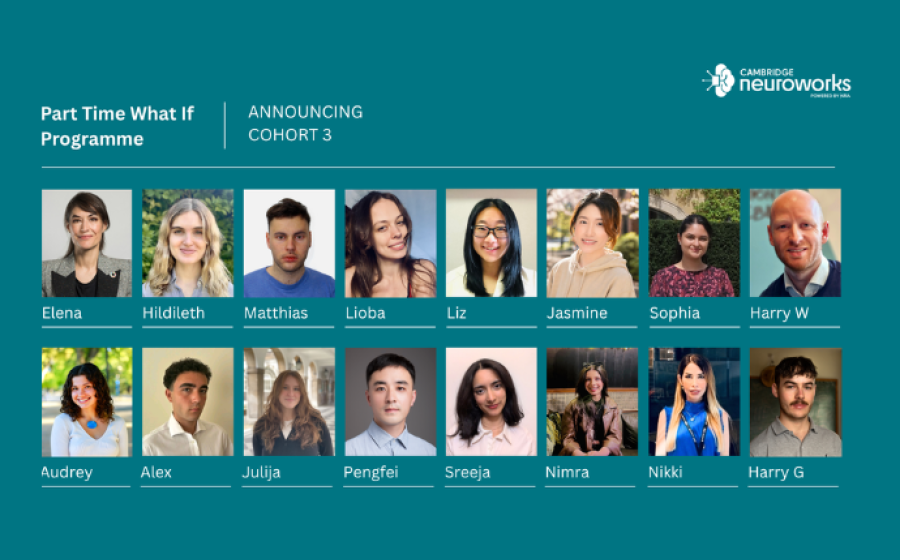
We’re thrilled to introduce our new cohort for the Part Time What If Programme!
We recently selected 18 innovators from across the UK, who will explore their bold neurotechnology ideas targeting unmet needs in neurology and brain health.
Through virtual sessions, peer-to-peer learning, and in-person Unconferences across the UK, our participants will refine their hypotheses and connect with ecosystem experts.
Read on to learn more about the inspiring individuals aboard our programme!
Nikolina
Clinical Lecturer in Psychiatry, King’s College London • Psychiatrist, South London and Maudsley NHS Foundation Trust
Working at the intersection between clinical neuroscience and experimental medicine, Nikolina will explore neuromodulation as a tool to understand and target brain circuit dysfunction. By rapidly "stress-testing" brain circuits in depression, Nikolina hopes to surpass traditional trial-and-error psychiatric approaches through trialling precision neuromodulatory treatments.
Elena
Emerging technology R&D consultant • Multidisciplinary product developer
Fuelled by 15 years' experience in wearables, embedded electronics and venture building, Elena joins the What If Programme as she builds NUROSAND: a multimodal AI approach combining neurotechnology with everyday wearables to better understand changes in behaviour and cognition over time. Her goal is to enable earlier, more personalised, and potentially preventative support.
Matthias
Wellcome Trust Optical Biology PhD Student • Research Excellence Scholar, University College London
Matthias develops neuro-photonic and machine-intelligence technologies to study the neuromodulation of decision making in zebrafish larvae: small vertebrates with transparent brains. During the What If Programme, he will explore their use as "in vivo testbeds" for novel precision neuropharmacology approaches.
Hildileth
Neuroscientist specialising in decision-making & deep learning
Hildelith studies the moments when decisions escape us: when threat signals surge through amygdala pathways over milliseconds, making the body move before the mind catches up. During the What If Programme, she is building a wearable system which senses this shift, and harnesses the body's own chemosignalling to create a real-time control channel steering behaviour back within the realm of conscious decision-making.
Lioba
PhD Researcher, University of Bristol • Research Associate in Translational Computational Psychiatry, University of Exeter
Lioba's work focuses on "virtual pharmacology": a framework combining scalable EEG technology with biophysical modelling to create mechanistic testbeds for brain circuit function. By deriving precise neural fingerprints, Lioba aims to streamline CNS drug development and improve trial-and-error prescribing with data-driven, personalised interventions.
Keir
MPhil Student, University of Cambridge MRC Cognition and Brain Sciences Unit
Keir was drawn to the What If Programme by a strong interest in non-invasive brain stimulation, particularly focused ultrasound stimulation. During the programme, Kier aims to create a more accessible, elegant and reliable method to administer transcranial ultrasound stimulation.
Liz
Researcher in AI for early dementia detection, University of Cambridge • Gates Senior Fellow, Alzheimer’s Disease Data Initiative
Liz develops clinically meaningful and scalable models to predict dementia risk before symptoms emerge. She integrates multimodal data, including cognitive measures, blood biomarkers, and neuroimaging, to build interpretable models which support early intervention and improve patient outcomes.
Jasmine
Cell & molecular biologist specialising in cell replacement therapies
Driven by inspiration from nature to address complex challenges in human health and sustainability, Jasmine explores how non-human biological systems can be engineered to perform neuron- and glia-like functions to offer a scalable, programmable approach to cell replacement therapy.
Sophia
Co-founder at AIble • First Associate Governor for Young People, St George’s Hospital Trust
With a background in neuroscience, the NHS, and business intelligence optimisation, Sophia is addressing a dementia crisis wherein 700,000 UK family carers shoulder unsustainable burden, while the NHS spends £300M+ on preventable emergencies. After co-founding AIble to address this, Sophia applied to the What If Programme to refine an approach to deliver personalised dementia care which preserves independence and dignity.
Harry W
Researcher at the intersection of neurotechnology, molecular biology and neurodegeneration
During the What If Programme, Harry plans to explore approaches enabling earlier diagnosis of Motor Neuron Disease. He is particularly interested in the identification of novel biomarkers and other emerging strategies that may support earlier intervention, improved disease monitoring, and more effective patient stratification for clinical trials.
Audrey
MSc Neuroscience Student, King’s College London
As a Neuroscience student, Audrey is currently studying neurodegeneration in ALS. She and her team are exploring a novel regenerative treatment for ischaemic stroke, harnessing AI-guided delivery of stem cells to affected regions of the brain.
Alex
Economics student, University of Strathclyde • Head of Business Development, DeepBrain
Alex has a strong interest in AI, entrepreneurship, and neurotechnology. At DeepBrain, he is developing a gentle brain stimulation system, guided by the body's signals to improve access to personalised brain health support. Through the What If Programme, Alex will explore how AI, neuroscience, and user-centred design can coalesce to support the next generation of brain health technologies.
Julija
MRes graduate in Systems and Synthetic Biology, Imperial College London • BSc in Biochemistry, King’s College London
Following her biological and biochemical training, Juluja has joined the What If Programme to bolster her work on stroke therapies. Along with her team, Julija is exploring a novel regenerative therapy for ischaemic stroke, focused on AI-guided delivery of stem cells to the brain.
Pengfei
Lecturer, Queen Mary University of London, specialising in computational photonics fused with AI
Pengfei is the lead developer of a massively scalable neural interface which routes ultra-thin optical fibers through the cerebral microvascular network to achieve single-neuron-scale, bidirectional control without transcranial surgery. By overcoming AI decoding limits through hardware-level physics, his work aims to deliver ultra-low latency, closed-loop treatments for conditions like ALS and Parkinson's disease.
Sreeja
Biomedical Engineering PhD Student, University of Glasgow
During her PhD, Sreeja is researching how to leverage tissue mechanics to coax monocytes towards microglial phenotypes, to aid in the study of neuroinflammatory diseases and the development of targeted immunotherapies.
Nimra
Trainee Psychiatrist
Nimra is passionate about bringing AI and technology into mental health. During the What If Programme, Nimra will work on a passive biosensing tool for autism assessment in adults with co-occurring intellectual disability. By tracking bodily signals to supplement clinical judgements with a rich evidence layer, Nimra hopes to better cater to a population currently underserved by existing assessment tools.
Nikki
Neuropsychology Researcher • Research Lead, Grae Matta Mental Health Foundation
Nikki specialises in episodic memory and the relationship between physiological state and cognitive performance. Nikki joined the programme to develop a proof-of-concept idea for a scalable, low-burden monitoring approach combining brief cognitive check-ins with physiological biomarkers. The goal is to improve interpretation of day-to-day variability between routine dementia reviews, to complement existing clinical assessment methods.
Harry G
Woolf Fisher Scholar, University of Cambridge
Harry's work focuses on restoring memory function. By understanding and recreating the neural computations which are performed by the brain but disrupted in early-stage dementias, Harry aims to translate these insights into developing neural prosthetics. This represents a bold new approach to address evolving treatment needs for a syndrome with rapidly increasing prevalence rates.
We'll share more on their progress soon!