How Cambridge NeuroWorks is helping Liam Collins-Jones form the future of Alzheimer’s Diagnostics
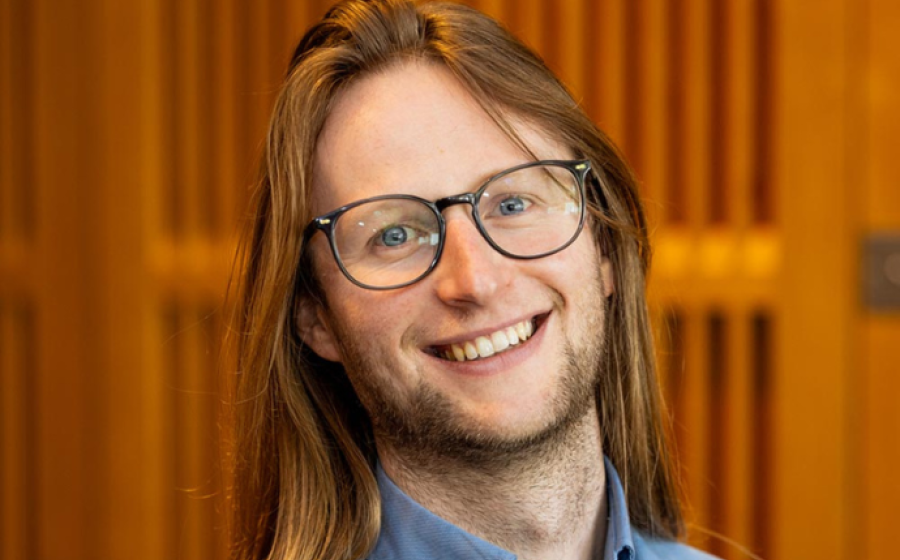
The path of a traditional academic can often feel like a series of safe, incremental steps. But for Liam Collins- Jones, a Cambridge NeuroWorks Blue Sky Fellow at the forefront of wearable brain imaging, "safe" wasn't enough to tackle the global challenge of Alzheimer’s disease. Through the Cambridge NeuroWorks programme, Liam has found the freedom to scrap conventional plans, embrace high-risk innovation, and bridge the gap between laboratory science and real-world clinical utility.
Reimagining brain imaging
Interviewer: To start off, could you tell us a bit about your project and how Cambridge NeuroWorks has supported you?
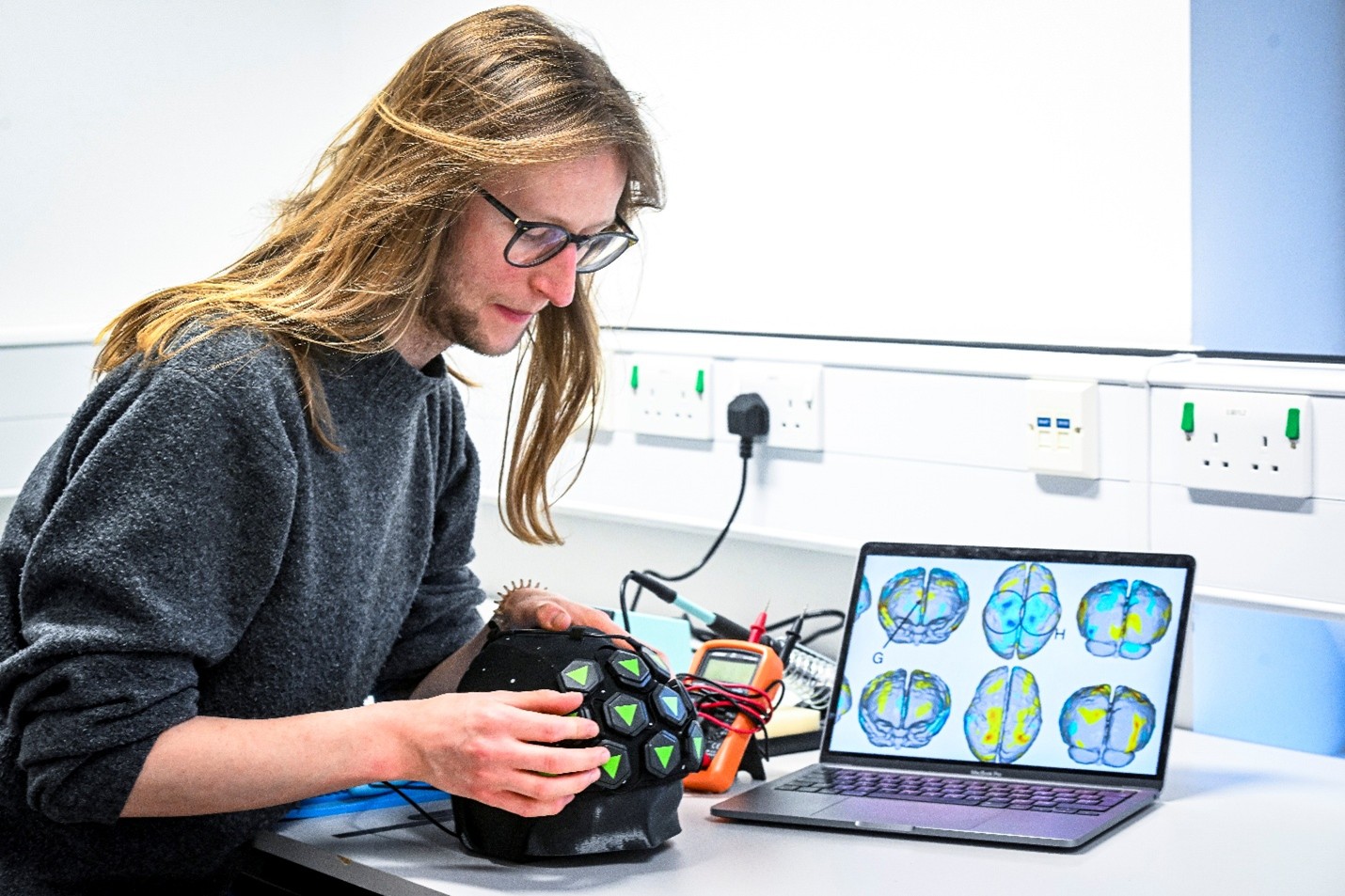
Liam Collins-Jones: I’m interested in how we can use wearable brain imaging tech to support Alzheimer’s disease diagnosis. Specifically, I’m using this technology to see if we can measure markers of cognitive activity directly from brain activity, instead of predominantly relying on cognitive ability tests to assess if, for example, people are writing or speaking accurately.
As part of the Cambridge NeuroWorks Blue Sky Fellowship, under the guidance of The Milner Therapeutics Institute, I spent the first few months really refining the approach - I actually ripped up my initial plans several times. In a typical traditional academic setting, you're often encouraged to be safe, but Cambridge NeuroWorks gave me the space to keep tearing up plans until I identified the specific engineering and technical approaches required to address the clinical problem. I am now applying this methodology in a pilot study with healthy participants, to see if we can find a clear association between brain activity and the difficulty of various cognitive tasks.
Interviewer: It’s fascinating work. Do you have plans to move into clinical trials with patients soon?
Liam Collins-Jones: That is exactly the next step. The goal of using healthy participants first is to see which tasks elicit the highest levels of brain activity and which regions are implicated. We can then use those regions as a "target" to look at in clinical populations. If we see certain activity levels in healthy brains, we want to see if those are replicated or diminished in patients. These brain activity levels are potential markers that could finally link cognitive impairment with hard brain activity data that can be applied in a clinic.
Bridging the biomarker gap
Interviewer: You’ve mentioned before that a lack of biomarkers is a major hurdle in diagnosing Alzheimer’s. How does your wearable neurotechnology differentiate from the present situation and change it?
Liam Collins-Jones: Right now, there’s a lot of clinical uncertainty because we don’t have an easy-to-access, brain-specific biomarker in clinics. We have Positron Emission Tomography (PET) and Magnetic Resonance Imaging (MRI) scanners, which are great, but they are expensive, immobile, and not equally distributed across the country. My research is about getting those same brain-specific biomarkers with much less effort and without needing those massive, expensive scanners.
Interviewer: It sounds like inclusivity and access are major drivers for you.
Liam Collins-Jones: Absolutely. These devices can essentially be plugged into a mains power point and they work. You don’t need a fleet of highly trained specialists to run them. That makes the technology more inclusive; more people could get access to a diagnosis that reduces uncertainty and helps inform their treatment earlier. I can envisage a future where this is widespread throughout the NHS.
Diminishing fears and the shift towards translational impact
Interviewer: Are you already working with the NHS to see how this fits into a real clinical setting?
Liam Collins-Jones: Yes, I’ve been having long discussions with clinicians to understand where this would fit in the diagnostic pathway and, crucially, what would make them skeptical about adopting the technology. I want to know their concerns so I can overcome them. That’s the big difference for me now — I'm not just expanding our understanding of the brain; I'm focused on how to make this actually useful.
Interviewer: That seems to align perfectly with the ethos of Cambridge NeuroWorks. How did you first hear about the program?
Liam Collins-Jones: I heard about it just before Christmas 2024. There was a lot of buzz among my colleagues. What drew me in was the focus on "high-risk" ideas. As a postdoc, I often felt frustrated that research had to be "safe" and incremental. I’m a big believer in the idea—similar to the ARIA approach—that innovation comes from step changes, not just small increases in knowledge. I put my hat in the ring thinking, "This might never pull off, but it’s worth a shot."
A new way of doing science
Interviewer: How has the Cambridge NeuroWorks structure specifically helped you move beyond that "frustrated academic" mindset?
Liam Collins-Jones: It’s opened my eyes to the translational and commercialisation aspects. In classical academia, you often write grants without a clear idea of how the work fits into a health system. Cambridge NeuroWorks teaches you who to talk to and what questions to ask. It’s a "foot in both camps"—we have the best of Cambridge’s academic environment, but we are also learning how to get research off the shelf and into the real world.
Interviewer: Does that mean you’re moving away from traditional publishing?
Liam Collins-Jones: Not necessarily, but the mindset has shifted. In academia, the paper is the ultimate output. Here, I’m thinking about what is best for the research. I do have publications on the horizon, but I’m being more strategic about it to ensure the work has the most impact.
Interviewer: Finally, how has the community of other fellows supported your journey?
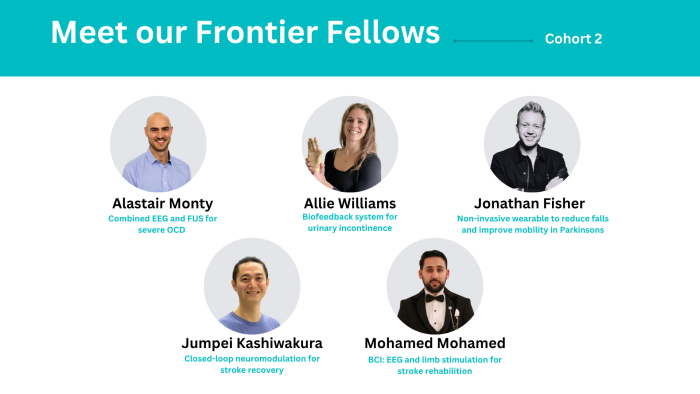
Liam Collins-Jones: It’s great to bounce ideas off the other Blue Sky Fellows. Even if our work is wildly different, we are at a similar stage of the journey, sharing the same frustrations of moving an idea from the lab to the next stage. Seeing the Frontier Fellows on their commercialisation journey also gives us a clear look at what the next steps could be. It’s a very supportive group.