Finding the balance: How Cambridge NeuroWorks reshaped a research path from pure academia to clinical application
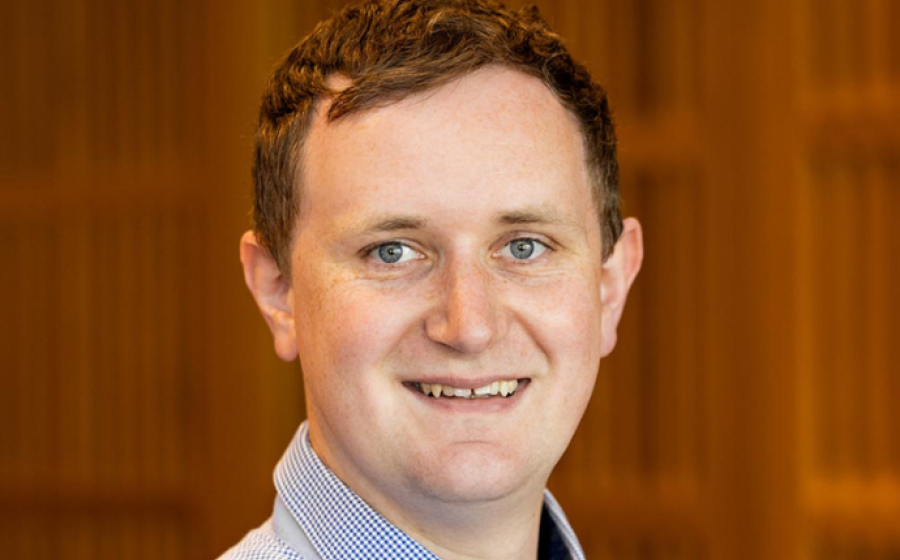
In the rapidly evolving landscape of neuroscience, the bridge between theoretical research and clinical application is often a difficult one to cross. For Iwan Roberts PhD, a researcher specializing in wearable health technology, the journey across that bridge was accelerated by a Frontier Fellowship with Cambridge NeuroWorks, powered by ARIA. Through strategic networking, exposure to industrial innovation, and a shift in mindset regarding "failure", Iwan’s time with the programme has not only refined his current work but has fundamentally reshaped his future research trajectory.
Transitioning beyond the academic "gray area"
Interviewer: To start us off, Iwan, how has your experience with Cambridge NeuroWorks shaped your professional journey so far?
Iwan Roberts: It has been instrumental in providing a necessary focal shift. We began as a fairly traditional academic project with high-level ambitions for clinical translation, but NeuroWorks provided the framework to get serious about the commercial and regulatory realities of that transition.
Before the programme, areas like usability engineering and medical device regulation felt like a "gray area" to us. The fellowship provided the time, space, and intellectual freedom to really run with those aspects. Unlike more generic accelerators, this programme offered access to subject matter experts from across medtech and neurotech who could challenge our assumptions based on industry experience. It moved us from "lab-scale" thinking to a holistic view of a medical product.
Interviewer: For those unfamiliar with your specific research, could you explain the core concept behind your technology?
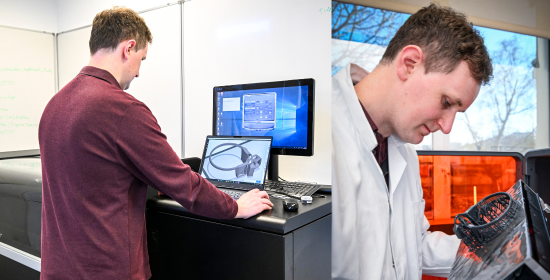
Iwan Roberts: We are developing an on-ear wearable device and an accompanying digital interface via an app on your phone or a laptop, to improve the accessibility of vestibular (balance) rehabilitation. Balance conditions affect a staggering portion of the population—over one-third of people over the age of 40 will experience a vestibular issue at some point.
The current "gold standard" for treatment is a specific form of physiotherapy involving precise head and eye movements to retrain neurological systems. However, patient access is a major bottleneck; people often wait years for a consultation only to receive a piece of paper with instructions. Our device uses sensors to derive objective metrics of movement, while the app acts as a "digital coach," providing a progressive, evidence-based system to deliver therapy in a way that is much friendlier and more measurable. In short, you wear the device and run through exercises on the app that help you cope with dizziness.
Quantifying clinical progress with objective metrics
Interviewer: You emphasized "objective measures." Why is quantification so critical for balance disorders?
Iwan Roberts: In many clinical settings, assessing balance is subjective, relying heavily on a clinician’s visual judgment. We want to supplement that with data. We recently conducted a study with 70 participants to establish a baseline, comparing our on-ear wearable data against optical motion tracking—the high-end technology used in Hollywood for motion capture.
By validating our sensors against these clinical "gold standards," we can quantify how people move in a way that is usable for a therapist. While many wearables track simple step counts, our system focuses on the nuances of vestibular movement. This has implications far beyond balance; we see a future where this could be used for stroke rehabilitation or monitoring Parkinson’s. By measuring movement decline in daily life, we can address "frailty" before it leads to falls, which are not only dangerous for patients and can lead to significant decline in their health, but also are a massive socioeconomic burden on the healthcare system.
Interviewer: It sounds like a unique approach. How did the Cambridge ecosystem help you navigate the early stages of this development?
Iwan Roberts: Being based in Cambridge, I was already attuned to the ecosystem. I had collaborated with Professor George Malliaras and followed the ARIA "scalable neurotechnologies" theme and the UK Neurotech scene for some time. The project itself was a collaboration with Professor Manohar Bance, an ENT surgeon, whose lab I had been a Postdoctoral Research Associate in, who saw the limitations of current balance clinics firsthand.
Cambridge NeuroWorks took that clinical interest and introduced us to the "builder mentality." Through the programme, we were mentored by specialists like the former VP of a Parkinson’s wearable company, who taught us about the complexities of reimbursement and commercial mapping. These are conversations you rarely have in pure academia.
A new philosophy: The "Builder Mentality" and patient-informed design
Interviewer: You’ve mentioned that NeuroWorks provided access to "operators" rather than just theorists. How did that change your day-to-day work?
Iwan Roberts: It was refreshing to work with people who have actually built companies—former CTOs and founders. They helped us bridge the gap between health economics and commercial modelling. Through introductions to experts at the NIHR BRC and Cambridge Enterprise, we began to understand how our device fits into the actual economic structure of the NHS.
It’s about more than just the technology; it’s about the "usability journey." We’ve used the fellowship to conduct formative studies on the hardware and software, ensuring that the design is informed by the patients and clinical stakeholders who will actually use it. Without that network, those high-level conversations with industry leaders would have taken years to facilitate.
Interviewer: What are the immediate next steps for your research team as you move toward clinical feasibility?
Iwan Roberts: We are currently preparing several grant applications and setting up a feasibility study for late 2025/early 2026. The goal is to move from our "scrappy prototype" to a clinically validated device. This requires ensuring our software is secure and that our hardware design—supported by the Cambridge Enterprise technology investment fund—is refined enough for real-world patient use. We’re also exploring collaborations with the new Institute of Biomedical Innovation to scale the idea further.
Advice for fellow academic researchers
Interviewer: Finally, what advice would you give to other researchers or medics who are considering applying for a Cambridge NeuroWorks fellowship?
Iwan Roberts: My main advice is to seek out structured thinking and mentorship as early as possible. Don't let your ideas scatter in a hundred directions. I personally find it helpful to create visual maps of the clinical, technical, and commercial aspects of the project so they can build upon one another. By “prototyping” each aspect of the company it’s been a really valuable way to communicate and challenge our thinking by engaging with expert mentors.
Most importantly, build with the clinical stakeholders and the patients in mind. You can develop the most sophisticated engineering in the world, but if the device sits in a drawer because it doesn't solve a practical problem, it has zero benefit. Cambridge NeuroWorks gives you the tools to ensure your research actually reaches the people who need it. It’s about building momentum and bringing people—patients, clinicians, and investors—along with you.